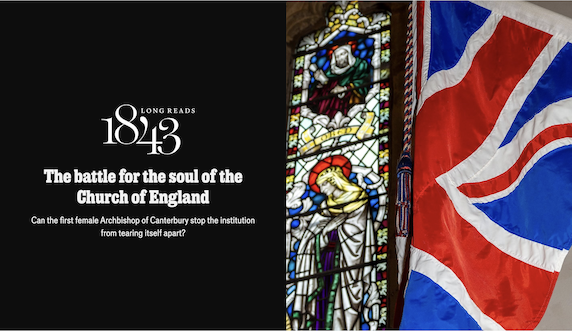
LGB Christians’ Mark Bratton wrote to The Economist in response to the article:
The Editor
The Economist, London, WC2N 6HT
NOT PUBLISHED to date
22 March 2026
Dear Editor,
It was surprising to find no mention in Georgia Banjio’s lengthy article of Archbishop Sarah Mullaly’s views on the current combustible questions of gender identity.
These questions raise profound ethical and theological issues on which one would expect the Archbishop to pronounce more explicitly than she has so far. As the first female Archbishop of Canterbury in a list stretching back over 1400 years, she is uniquely well-placed to offer powerful, situated insights into the conflict between women’s rights and the legal and political aspirations of men claiming a ‘female’ gender identity, especially the right to access single-sex spaces and to participate in female sports.
This is to say nothing of the way in which gender identity ideology has been encouraging irretrievably damaging medical and surgical interventions on the bodies of children and young people, most of whom are not sufficiently mature to understand the long-term implications of the treatments to which their current, urgent, and anxious desires are causing them to assent. This constitutes a safeguarding crisis against which recent scandals, one of which precipitated the unprecedented resignation of a previous occupant of her office, pale into insignificance. Indeed, it may come to be regarded as the worst medical ethics atrocity of this century.
Following her recent powerful speeches in the House of Lords on issues of abortion, euthanasia, and physician-assisted suicide, where she has drawn on the theological insights of the Christian tradition, it is odd that she has circumvented robust theological engagement with one of the key ethical issues of our age, beyond rather anodyne statements about the importance of compassion, inclusion, and proper pastoral care.
More importantly, as the Church of England’s chief pastor and teacher, she is called to address the more profound theological questions which gender identity ideology raises. In particular, it is startling that she has not pronounced upon the utter incompatibility of an ideology that holds to the metaphysical existence of a gender identity that varies independently of physical sex with the Christian view that human beings are integrated totalities of body, mind, and spirit.
Indeed, the notion that a person’s true identity can be dissociated from their embodied reality underpins the powerful, well-funded, and increasingly influential ‘transhumanist’ movement that seeks to radically transform the human condition in ways that denigrate the created order, which in the Christian narrative, God has repeatedly declared ‘very good’.
It is my hope that her combination of healthcare experience, built up over many years as a nurse, and pastoral experience as a priest and bishop, will enable her to make a uniquely powerful contribution in this key area of cultural conflict.
Rev Dr Canon Mark Q Bratton