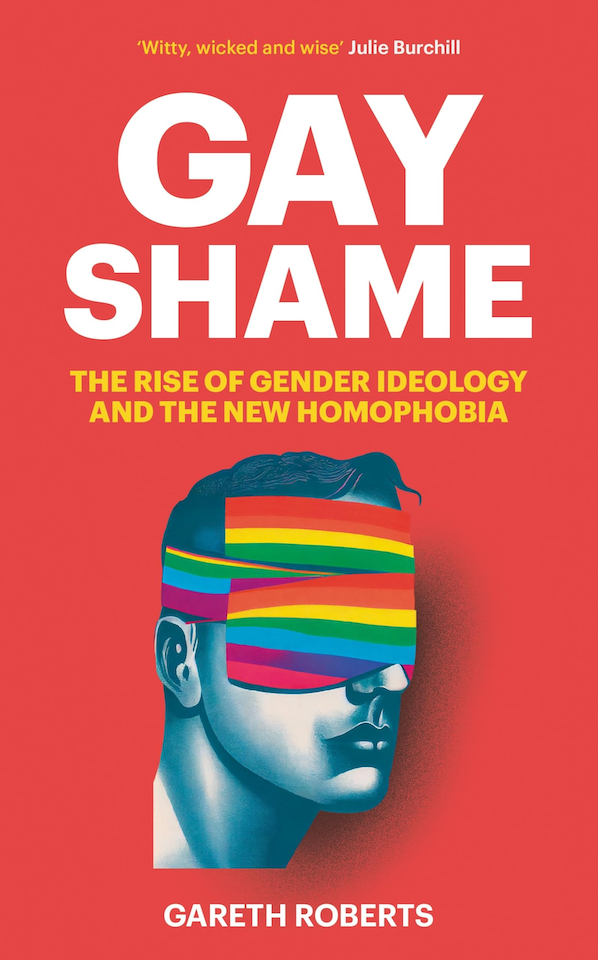
Read LGB Christians’ review of Gay Shame: Gender Ideology and the New Homophobia.
Book review
by Jonathan Wheeler
Gay Shame – Gareth Roberts (Swift Press – Forum, 2024)
This is not a book written specifically for religious individuals. However for me, as a Christian and same-sex attracted man, I found it hugely helpful in navigating what is going on in the broader UK culture relating to Gender and how the LGB movement morphed into LGBT+.
I finished the book in about two sittings, even though it is 250 pages long. At no point is there anything in this book which a traditional Christian would have any objections to.
Gareth (who grew up in the 1980’s has written a very engaging (and surprisingly funny) book about how the British Gay rights movement was taken over by a Trans agenda, to the extent where same-sex attracted people are being actively harmed by most mainstream LGBT+ charitable bodies in the UK.
The ‘leap’ is that, by bringing Trans people into the LGB grouping, you have to ignore the reality that there are only two sexes which are immutable and it is not possible to change your sex
Gareth tracks how, by 2015, same-sex attracted people in the UK had basically achieved everything the campaigners had been petitioning for (achieving equal legal rights in the UK, even up to the point of being able to marry). At this point Stonewall UK had a significant campaigning organisation and staff and they essentially had nothing left to campaign for. In order to maintain their reason for existence, they decided to move into the Trans campaigning space, ignoring a number of LGB people who warned them against doing this. This required (on Stonewall’s part) what Gareth calls a ‘mental leap’. The ‘leap’ is that, by bringing Trans people into the LGB grouping, you have to ignore the reality that there are only two sexes which are immutable and it is not possible to change your sex. This mental leap requires the belief that a man can fully become a woman in every sense and therefore assume the rights previously only given to women. Some of the rights lost by women are, as a result, the right for women to associate without men (who identify as women) in their spaces, the right to single-sex wards in NHS hospitals, the right to not have biological men incarcerated with them in female prisons or shelter in women’s refuges without men present or even to be able to compete only against women in specifically women’s sporting categories.
We know the obvious reality that a same-sex attracted man is not going to be attracted to a woman simply because she feels that her inner ‘gender identity’ is male.
However, the ‘Genderist’ movement (as he neatly calls it) also required that the definition of homosexuality be changed from someone who is same-sex attracted to someone who is same-gender attracted. This may seem like an unimportant semantic point, but it essentially makes same-sex attraction meaningless. We know the obvious reality that a same-sex attracted man is not going to be attracted to a woman simply because she feels that her inner ‘gender identity’ is male. To believe otherwise is self-evident nonsense, but it is the mantra that we have been bullied into adopting since 2015.
Young same-sex attracted people are being led to believe that you can actually change your sex.
Whatever we as Christians believe regarding the sinfulness of same-sex attracted relationships, what this new Genderism movement has resulted in is the ideological indoctrination of same-sex attracted young people to believe that they are not same-sex attracted, but they are in fact ‘Trans’. The result has been a 100-fold increase in UK referrals to Gender clinics since 2014-15 which has led to puberty blockers and then cross-sex hormones for many. Young same-sex attracted people (over 80% of referrals are same-sex attracted people, according to the recently published Cass review) are being led to believe (by a combination of teaching materials in schools, broadcast media, the entertainment industry and guidance received through ‘gender dysphoria’ treatment in the NHS) that you can actually change your sex. This is even though anyone thinking rationally knows this is an impossibility. Anyone daring to speak this obvious truth is hounded out of their jobs or the public space by HR functions and activists who are promoting a skewed comprehension of ‘diversity’ and also reflecting the Equality Act as Stonewall would like it to be (rather than actually detailed in the Equality Act itself).
Banning trans conversion therapy means mandating gay conversion therapy.
The terminology used by this activist movement also uses the term ‘Conversion therapy’ to mean stopping a person from accepting their gender identity (as the person self-declares it). However, what this would lead to in reality would mean actively promoting Gay conversion therapy, by pushing essentially same-sex attracted young people into gender stereotypes and thereby pushing them into gender reassignment. To be clear here, banning trans conversion therapy means mandating gay conversion therapy.
At the end of the book, he describes two possible futures, one where we row back to a reality grounded discourse and on the other, we enable safeguarding issues to avoid accusations of bigotry.
I think this book is useful from a Christian standpoint. For many years now, the Church of England has been progressing with its ‘Living in Love and Faith’ initiative, in order to discern how same-sex attracted people should be considered, both theologically and pastorally. Publications, such as Bishop of Oxford’s essay (‘Together in Love and Faith’, 2022) where he makes the case for LGBT+ relationships to be affirmed by the church would, I believe, have been much more persuasive if they were not discussed as encompassing the entire umbrella of ‘LGBT+’ people. If Bishop Stephen (and others) are going to take a theologically coherent position, it makes sense to treat same-sex attraction as different to people who profess they are not in the right body at all. This is their body, remember, which is created by God. The theological considerations for these two groups are therefore fundamentally different and yet LGBT+ activist groups are asserting that these are all the same group of people without pausing to consider the differing impacts. Whether you think same-sex attracted relationships are God-inspired or not, your eventual position is absolutely capable of being different for same-sex relationships compared to how Trans identified people should be theologically and pastorally treated. Personally speaking, I can just about theologically understand that God might be willing to permit same-sex monogamous relationships in a fallen world (as it is not good for man to be alone) in much the same way Moses allowed divorce, for example, even though this was not God’s design. But it does not automatically follow that God would be happy for young people to take medical treatments to prevent the natural onset of puberty and have healthy body parts surgically removed, just in order to present as an approximation of the opposite sex (and all the damaging life-long medical issues that clearly result for those individuals).
Even if you disagree with some of Gareth’s book, where you will almost certainly agree is that he asks (in the conclusion) that we try and treat same-sex attraction as simply a small part of our identity and to look beyond the historical stereotypes to understand how better we can live our real and healthy selves. He also signposts other newer groups such as LGB Alliance, who do not favour an LGBT+ group-wide approach.
Gareth’s book is a coherent and persuasive book and as a Christian and same-sex attracted man, I recommend it to you.
We asked Johnathan why he wanted to write for us, what experience he brings and what he’d most like to see for LGB Christians and our friends.

Johnathan Wheeler
Q: Why did I want to write for LGB Christians?
As a lay member of the Church of England, in the Diocese of Oxford and as a same-sex attracted man who does not go along with gender identity ideology, I am keen to understand the issues better.
Q: What experience do I bring?
I’ve been a member of the Church of England for 20 years and on my local church PCC for most of that time. I also work in the private sector (for a software company) as well as having been a member of the Army Reserves for over 15 years. In all those varied environments I can see the impacts of gender ideology and how well meaning people (who do not understand its impacts) are being pressured to go along with activist organisations that do not have LGB interests at their root.
Q: What change would I most like to see for LGB Christians and our friends?
That we continue to take a nuanced and rigorous theological and pastoral approach to LGB issues for Christian members of the faith, whilst holding on to the wider importance of the entire Christian fellowship’s purpose here on earth, which is to bring about God’s Kingdom.