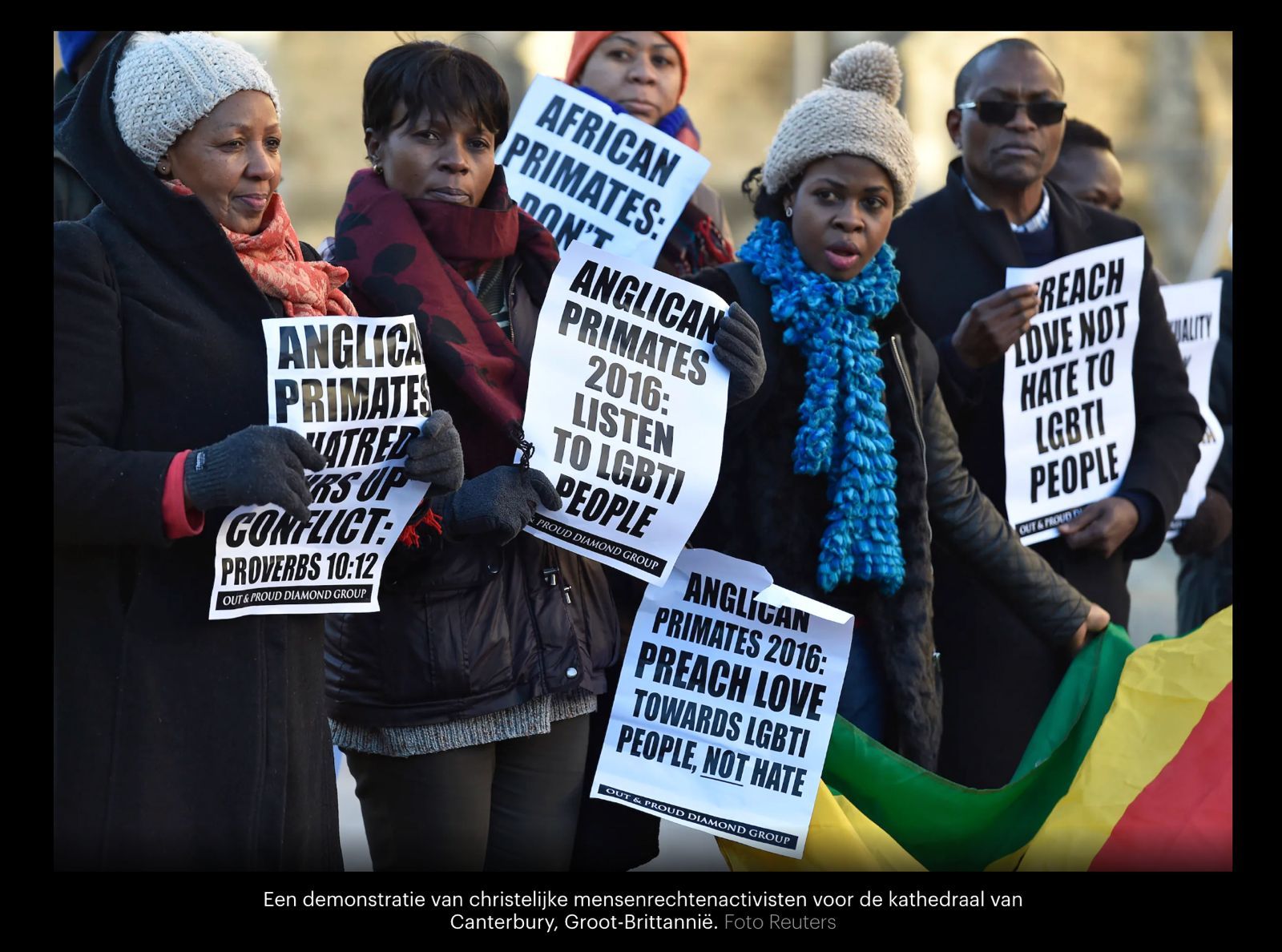
Niles Posthumus interviews Richard Kirker and Revd Charlie Bączyk-Bell for Trouw, a Dutch newspaper about the latest stemate in a 60 year long battle for same-sex marriage/blessings.
You can visit the original article (although there is a paywall) here: https://www.trouw.nl/religie-filosofie/frustratie-bij-homoseksuele-anglicanen-hun-kerk-gaat-homostellen-toch-niet-inzegenen~b3495af5/
DOWNLOAD A PDF COPY OF THE ARTICLE – Dutch Newspaper Trouw March 2026

Dutch Newspaper Trouw
March 3, 2026
Deeply divided Anglican Church
will not bless same-sex couples after all
The Church of England will not, for now, permit the blessing ceremonies of same-sex couples. Campaigners are deeply disappointed. “It is depressing and tiresome.”
“Deep frustration” is how the Revd Charlie Bączyk-Bell describes his feelings. Two weeks after the governing body of the Church of England voted to halt plans to extend equal rights to LGBT members and clergy, his anger has not subsided.
At the Church’s General Synod, which meets twice a year, 252 voting members backed suspending the LGBT process called Living in Love and Faith, while 132 wished to continue. Among bishops, the vote was 34 to 0, with two abstentions.
In 2023, the Church of England — the largest and historically leading church within the global Anglican church — concluded that it could not endorse same-sex marriage. Even though the Scottish Episcopal Church, also Anglican, has permitted it since 2017. But instead, the Church of England did propose allowing blessing ceremonies – which would be similar to but not official marriages – for same-sex couples, as a compromise.
A process was duly launched to determine how such ceremonies might take shape. But after three years of discussion, and even fifty years of debate already before that, agreement has simply proved elusive.
Therefore, the synod decided in February: stand-alone blessings ceremonies for same-sex couples will therefore remain off the table for now. And clergy are also still officially prohibited from entering into even a civil same-sex marriage.
The outcome did not surprise Richard Kirker. “It is, sadly, all too predictable”, he says. “The factions and interest groups within the Church are just as clearly divided as ever.”
Kirker has campaigned against homophobia within Christian faith for half a century. His organisation, LGB Christians, is ecumenical. But he himself trained as a minister in the Church of England. He later lost that position, however, after speaking too frequently and too openly about his sexuality – and about discrimination based on that within the Church.
Globally, the dispute even brought the Anglican
church close to schism.
For years, he says, an unspoken “don’t ask, don’t tell” approach prevailed — along with a saying he despises: love the sinner, hate the sin. In practice, that meant gay clergy were tolerated only if they remained celibate. Absurd, he argues. “Suppressing your sexuality can have many consequences: it can make you sad, lonely, disappointed and embittered, since you are constantly at war with yourself. But one thing it will never do is make you less homosexual.” The taboo had to be broken.
Yet opening the debate proved, in his words, like “stirring up a hornets’ nest”. Supporters and opponents of same-sex marriage became ever more entrenched. Globally, the dispute even brought the Anglican church close to schism.
The 2023 decision to allow gay blessing ceremonies was poorly received by church leaders in countries including South Sudan, Uganda and the Democratic Republic of Congo. Some declared that they no longer recognised the then Archbishop of Canterbury as the head of the worldwide Communion.
But to label those leaders “homophobic”, as some did, was “unjust”, argued the conservative London synod member Busola Sodeinde during February’s gathering. After all, they believed they were simply “seeking to remain faithful to the word of God”.
The conservative alliance of Anglican leaders known as Alliance had by then already expressed its regret at the hurt experienced by LGBT members during the debate. But it also urged the Church not to overlook the “deep pain” felt by conservatives who, “as a matter of conscience, find it simply impossible to accept change to the historically received doctrine of marriage” within their church.
Therefore, during the synod, Church leaders apologised for “the distress and pain” felt on “both sides” of the debate. That formulation angered Bączyk-Bell. The pain of conservatives, he said, “is not the same as the grief you feel when your entire being is questioned, dissected and criticised”.
Kirker argues that the conservative faction is simply better funded and more effectively organised than the more progressive faction. “Our opponents — there is no other way to describe them — do mobilise very efficiently. They constantly frighten their grassroots supporters, portraying the world as if it is about to be taken over by gay people.”
The problem, he adds wryly, is not that the Church has failed to address homosexuality. “The problem is that since the 1970s, it has been unable to formulate a solution.” Other once-divisive issues — divorce, contraception, the ordination of women — were eventually resolved. In those cases though, he concedes, the eventual settlement also aligned with the interests of the heterosexual majority.
That is not the case with LGBT inclusion. The conservative evangelical network within the Church, the Church of England Evangelical Council (CEEC), has stated plainly that blessings for same-sex couples would be “contrary to biblical teaching”. Kirker struggles to accept that argument. “If you believe in a Christian faith in which all are created equal — wit no ifs and buts, no qualifications — then the theological basis for same-sex marriage seems to be in place already.”
For Bączyk-Bell, the choice of the church must therefore be seen more as a political than as a theological one. “The bishops fear that if gay couple blessings are permitted, some people will leave the church. But they forget that many gay Christians already stay away because they do not feel welcome. But they simply leave quietly, which is the reason that it attracts less attention.”
Still, he retains hope. Later this year, new Synod members will be elected. And the LGBT topic will be back on the agenda in two years’ time. Until then, a new working group on “relationships, sexuality and gender” is to continue the discussion.
The new Archbishop of Canterbury, Sarah Mullally, widely regarded as fairly progressive, told February’s synod that continuing the conversation was “a wise way forward” and that it “will take us to “the next steps”. She acknowledged, however, that the acrimony had caused considerable harm and “left us wounded as individuals and as a Church”.
Meanwhile, Bączyk-Bell thinks there will be a degree of clerical disobedience. Because, for added complexity, while stand-alone blessings ceremonies are not allowed, blessing prayers for same-sex couples within regular Sunday services are permitted. And such blessing prayers might be used to give gay couples some sort of blessing, without a stand-alone ceremony, after all.
“Some clergy will simply ignore the rules,” he predicts. He admits that this could result in “disorderly breakdown” from below. “We will just do what, we think, is right.” He himself is an example of this. “I got married to my husband in contravention of the Church ruling. Because those rules are stupid.” And well, the Church has chosen to turn a blind eye.
Bączyk-Bell sighs. “The tragedy is how many more people must not come to church any more, or be damaged, before we finally get a grip on this. Everybody knows that in the long-term, acceptance of same-sex marriage is inevitable. It is precisely why the whole process is so depressing — and tiresome.”
Reprinted in English, with permission, by LGB Christians
LGB Christians, 27 Old Gloucester Street London, WC1N 3AX, UK
www.lgbchristians.org.uk 4th March 2026