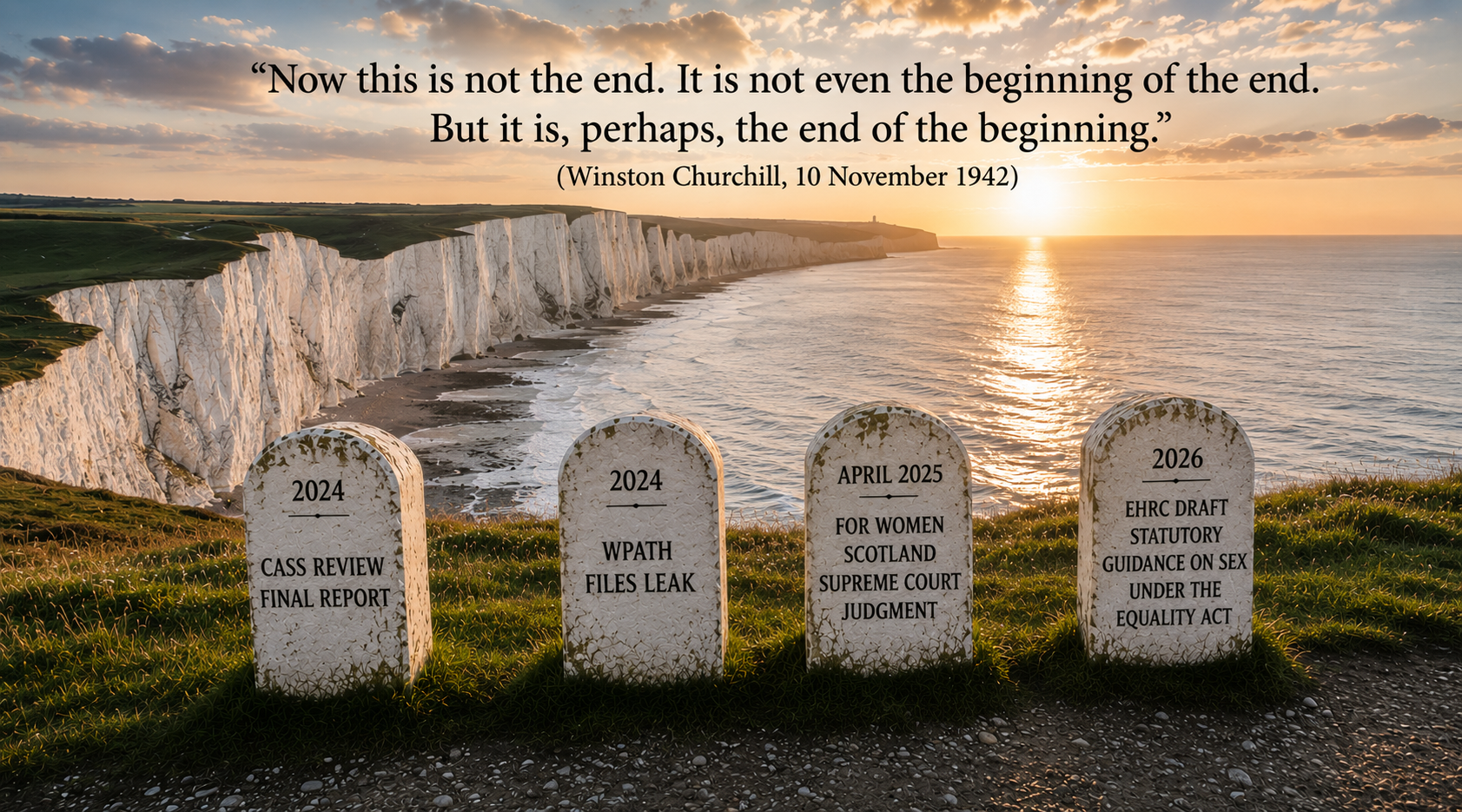
“Now this is not the end. It is not even the beginning of the end. But it is, perhaps, the end of the beginning.”
Mark Bratton takes us through the milestones in the ongoing war against gender identity ideology and the misplaced legal and social aspirations of transactivist individuals and organisations.
Winston Churchill delivered these iconic lines during the Lord Mayor’s Luncheon at the Mansion House in London on 10 November 1942, shortly after the Allies achieved a significant victory at the Second Battle of El Alamein. Although this battle represented a turning point in the war, the conflict was far from over.
One of the Worst Cases of Mass Irrationality in my Lifetime
When LGB Christians was launched in 2023, the fight against gender identity ideology seemed as bleak as the retreat from Dunkirk in 1940. The idea that people could change their sex or that gender could be separate from sex was deeply rooted in major institutions such as the BBC, civil service, most universities, and even Parliament. Watching prominent politicians struggle and squirm while giving incoherent answers to questions like ‘What is a woman?’ or ‘Does a woman have a penis?’ vividly showed that the UK was experiencing one of the worst cases of mass irrationality in my lifetime. Strict rules against ‘misgendering,’ enforced through discipline or expulsion in these institutions, marked an unprecedented level of coercive control over speech and thought. Even the Church of England took a broadly affirming and supportive approach toward transgender and gender-questioning pupils, heavily influenced by the recommendations of the British LGBTQ+ rights charity and advocacy organisation Stonewall, in the later versions of its document Valuing All God’s Children.
Signs of Hope
However, there were signs of hope. In 2020, Keira Bell’s largely unsuccessful judicial review highlighted the therapeutic limitations of the only NHS specialist gender identity service for children and adolescents in England and Wales, as well as the uncertain evidence underpinning paediatric gender medicine (PGM). These issues were further emphasised in Hilary Cass’s Interim Report in 2022, which led to the service’s closure shortly afterwards. In 2021, in the Forstater case, an Employment Appeal Tribunal held that gender-critical beliefs – including the belief that biological sex is real, important and immutable – were protected as philosophical beliefs under the UK Equality Act 2010 (EA). In January 2023, for the first time, the UK Government invoked special powers under the Scotland Act to prevent a Scottish Bill that would have introduced gender self-identification into Scottish law. ‘Gender-critical’ advocacy groups, such as Sex Matters (founded in 2021), were pooling legal, medical, and political expertise to protect and promote gay and women’s rights.
Nevertheless, these developments did not even mark the ‘end of the beginning’ of the battle against gender ideology. Gender identity ideology, along with self-identification and the gender-affirming practices it supported, was still on the rise, if not already triumphant.
Since the launch of LGB Christians, various legal, political, and scientific advancements have started to weaken the influence of gender ideology on institutional and public awareness. I have chosen three major ‘milestones’ in the ongoing war against gender identity ideology and the misplaced legal and social aspirations of transactivist individuals and organisations. It is opportune to consider these as our organisation seeks to adopt a new legal structure and become a Charitable Incorporated Organisation
The meaning of ‘sex’
A major milestone was the UK’s highest court rejection of self-identification or medical diagnosis as the legal determinant of sex – the For Women Scotland case
In April 2025, in a landmark decision, the Supreme Court (SC) clarified that, under the UK Equality Act 2010, the terms ‘woman’ and ‘sex’ specifically refer to biological sex rather than gender identity certified by a Gender Recognition Certificate. Additionally, a trans-identifying individual who claims the protected characteristic of gender reassignment does not consequently gain the protected characteristic of the opposite sex.
What the Law had Been All Along
The legal and policy implications of the judgment are immense. In its judgment, the SC ‘declared’ what the law had been all along, rather than creating new law, with key implications for single-sex spaces and services, sport, public bodies and quotas, and sexual orientation protections.
Nonetheless, trans activist organisations tried to downplay the significance of the judgment by claiming it was based on narrow reasoning and therefore has limited relevance. They have applied pressure on the Equality and Human Rights Commission (EHRC), pursued judicial review challenges against the EHRC, and lobbied government agencies and employers. Despite the clarity, comprehensiveness and wisdom of the SC judgement, claims to sex-based rights, especially in the employment context, are still matters of contestation (e.g. Sandie Peggie and the Darlington nurses).
The role of evidence: The Cass Final Report
The 2024 publication of the Cass Review marked another significant milestone.
Led by renowned paediatrician Dr Hilary Cass, it is the most comprehensive evaluation of PGM effectiveness to date. The review’s findings are grounded in seven systematic reviews—the most stringent type of clinical research—and over 1,000 interviews. The report concluded that there is a lack of sufficient high-quality evidence to verify that puberty blockers or synthetic hormones reliably improve long-term mental health outcomes in young people with gender dysphoria. It also raised concerns that many children may be initiated on medical treatment pathways without a proper psychological assessment.
The Review notably criticised the eighth edition of the Standards of Care (SOC 8 – 2022), issued by the World Professional Association for Transgender Health (WPATH), for lacking a thorough developmental process and for its ‘circular approach.’ It pointed out that the authors did not conduct a systematic review of evidence prior to making recommendations. Ironically, although SOC 8 claims to be based on systematic reviews, unsealed court documents from American litigation have shown that WPATH pressured Johns Hopkins University not to publish the findings of the eight systematic reviews it commissioned, especially when those findings indicated weak or inconclusive evidence.
The Ongoing Influence of Ideology
Incongruously, WPATH criticised the Cass Review for its author’s limited experience with gender-dysphoric children and its methodology. Likewise, a report by the Yale Integrity Unity, authored by leading GAC clinicians, criticised the Review as well, but without relying on systematic research. This report was submitted as an amicus brief in litigation and revealed in disclosure rather than in a peer-reviewed academic publication as a scientifically neutral evaluation of the evidence. The British Medical Association initially responded critically to Cass along similar lines, but has recently moved closer to Cass regarding the evidence quality, revealing the politicised disputes within the major doctors’ union.
The ongoing influence of ideology on the evaluation and interpretation of evidence was evident in a recent large-scale data study in Finland. This study found significantly higher rates of severe psychiatric issues among young people referred to gender clinics compared to the general population. It strengthened wider Nordic and Cass Review concerns regarding psychiatric comorbidity and the complexity of youth gender referrals. Trans activist critics targeted the lead researcher, especially her connections to more sceptical views on youth transition and the ideological perspective those views embody.
The ‘dark heart’ of gender medicine: the WPATH Files
A third milestone was the leaked disclosure of the so-called WPATH files in 2024.
Journalist Michael Schellenberger and analyst Mia Hughes published internal messages and documents from WPATH, revealing notable ethical disagreements among clinicians in gender medicine. A key issue was whether young children and adolescents can truly understand the implications of PGM for informed consent, echoing the central legal question in the Keira Bell case. Despite public criticisms, WPATH, aligning with the Cass Review, admitted that the evidence for interventions—particularly long-term data—remains limited. One of the most surprising admissions came from clinician Marci Bowers, who stated that children beginning puberty blockers at the start of puberty might later lose the ability to orgasm. She said she was “unaware of an individual claiming ability to orgasm when they were blocked at Tanner 2 [meaning very early puberty],” Perhaps most shocking was the admission that explicit age limits could create legal and political difficulties for accessing gender-affirming care.
The WPATH documents are important because they support some of the points made in the Cass Review regarding uncertainty in the evidence. They also dispute claims from WPATH and other supportive clinicians that there is unified backing for GAC, and they highlight the conflicts among activism, clinical practice, and standards of evidence. These tensions are particularly significant given WPATH’s strong influence on major American medical organisations, including the American Medical Association, the American Academy of Paediatrics, the Endocrine Society, and the American Psychological Association. While these organisations have not formally denounced WPATH following the leaks, publication of the Cass Review, and shifts in European practice, there are growing signs of caution, a focus on evidence-based practices, and increased recognition of the weak evidence base. In 2026, the American Society of Plastic Surgeons became the first major US medical group to recommend against gender surgery for minors under 19, citing lack of evidence and moving away from the more permissive approach of WPATH SOC 8. The BMA’s recent open support for Cass reflects a similar trend.
The end of the beginning?
Churchill’s statement remains relevant because it highlights both the importance and the limitations of a critical moment. Over the last five years, legal, scientific, and political advances have significantly reduced the influence of gender identity ideology in public discourse. Ideas once considered untouchable are now openly questioned. Courts have reinforced the legal recognition of biological sex. Major reviews have revealed the shaky evidential basis of paediatric gender medicine. Additionally, internal disagreements among leading clinicians and organisations are now harder to hide behind claims of “settled science” or a unified professional stance.
However, it is too early to celebrate victory. Many institutions that strongly support gender ideology still resist genuine reform. Activist groups continue to pressure employers, schools, churches, medical organisations, and governments. In numerous professional and educational environments, individuals often fear reputational damage or disciplinary actions when voicing common beliefs about sex, homosexuality, and the human body. Scientific discussion remains susceptible to ideological bias, and the challenges related to protecting vulnerable children and adolescents remain unresolved.
A Moral, Pastoral and Intellectual Task
For LGB Christians, these developments are grounds neither for triumphalism nor despair. They demonstrate that cultural and institutional change is possible but also fragile. The task ahead is not merely political or legal. It is moral, pastoral, and intellectual. It requires defending the reality of biological sex, protecting vulnerable children from experimental medical pathways, safeguarding freedom of conscience and expression, and resisting pressures that undermine the dignity of lesbian, gay, and bisexual people.
LGB Christians aim to uphold truth compassionately, advocate for evidence-based and ethical practices, defend freedom of belief and expression, and ensure Christian witness aligns with biological realities and safeguarding duties towards children and vulnerable individuals.
It remains unclear whether this moment signals the start of the decline of gender identity ideology or just the early stages of resistance against it. What is certain is that assumptions once considered unquestionable are now being openly, rigorously, and increasingly courageously challenged. This alone signifies a significant shift.
Addendum
After a considerable delay, the Equalities and Human Rights Commission (EHRC) has just laid before Parliament its revised draft statutory guidance on defining and treating ‘sex’ under the Equality Act 2010. Parliament has 40 days to review this draft before it becomes law. The update reflects the Supreme Court’s decision in the For Women Scotland case from the previous year (see above).
Courts and tribunals will be expected to consider this guidance where relevant, but will not be obligated to follow it if they find it does not accurately represent the legislation or judicial rulings. Despite some transactivist groups’ public claims, such as Stonewall’s, the guidance does not establish new law; however, it will significantly influence how current law is enforced and interpreted. Service providers and associations will be expected to comply with the Supreme Court judgment, now and in the future.
The guidance aligns with the SC ruling, clarifying that within equality legislation, the protected characteristic of ‘sex’ refers to biological or natal sex, not a certificated or self-identified sex. As a result, trans-identifying people, whether or not they hold a Gender Recognition Certificate, cannot be treated as the opposite sex under equality law. Additionally, claiming the protected characteristic of gender reassignment does not confer the protected characteristic of the opposite sex. It is unnecessary to balance protected characteristics because they do not intersect.
Damaging, Socially Destructive, and Confused Belief System
Excluding trans-identifying individuals from single-sex spaces, sex-specific services, and sports categories, although disadvantageous to them, is justified because it prioritises female safety, privacy, and dignity where women face greater risks. Allowing trans-identified individuals into these spaces would turn them into mixed-sex environments and could be considered unlawful discrimination against women. Legally, reasonable accommodations for trans-identified people can be provided as good practice, but there is no compulsory legal requirement to do so.
Once the draft is officially classified as statutory guidance, it will represent a fourth key ‘milestone’ in the fight against gender identity ideology. This could signal the start of the inexorable decline of this damaging, socially destructive, and confused belief system, “the beginning of the end”.
Mark Bratton is an ethicist, lawyer, and an anglican parish priest, serving as the Rector of St John the Baptist, Berkswell and as an honorary lecturer in medical ethics and law at the Warwick Medical School. Additionally, he is an Honorary Canon of Coventry Cathedral and is trained as a barrister.